|
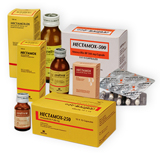
Hectamox
Amoxycillin Capsule/Suspension/Drops
DISCRIPTION
Hectamox contains Amoxycillin BP as trihydrate
which is chemically D (-) - - amino-p-hydroxy-benzylpenicillin.
It is a broad spectrum, bactericidal antibiotic similar
to ampicillin in the spectrum of activity but is better
absorbed when taken orally and produces a higher blood
level.
INDICATION
Hectamox is indicated in the following bacterial
infections :
--> Infections of the respiratory tract &
ear : Laryngitis, Pharyngitis, Tonsillitis, Sinusitis.
--> Infections of the billiary and G.I. tract
: Salmonellosis including the carrier stage, Choleccystitis,
Peritonitis.
--> Infections of the genito-urinary tract : Nephritis,
Pyelitis, Pyelonephritis, Cystitis, Urethritis and Gonorrhea
Bacteriuria in pregnancy Gynecological infections including
puerperal sepsis and septic abortion.
--> Skin and soft tissue infections : Boils,
Carbuncles, Cellulitis, pre-and post-operative prophylaxis.
--> Bacterial endocaditis
--> Septicemia
--> Osteomyelitis
--> Prophylaxis of endocarditis : Hectamox
may be used for the prevention of bacteraemia, associated
with procediures such as dental extraction, in patients
at risk of developing bacterial endocarditis.
CLINICAL PHARMACOLOGY
Amoxycillin is an orally active semi-synthetic penicillin.
amoxycillin is readily hydrolysed by the staphylococcal
penecillinase. Benzyl ring in the side chain of amoxycillin
extends the renge of antimicrobial activity into the
Gram-negerive bacteria. Amoxicillin kills bacteria by
interfering with the synthesis of the bacterial cell
wall. Peptidoglycan provides the mechanical stability
of cell wall. The final stage of peptidoglycan synthesis
involves the completion of the pentaglycine bridge is
linked to the fourth residue of the pentapetide (d-alanine).
The transpeptidase enzyme that performs this step is
inhibited by penicillins. As a result the bacterial
cell wall is weakened, the cell swells and ruptures.
Amoxycillin is more acid stable than benzylpenicillin.
It is more rapidly and completely absorbed from the
gastrointestinal tract after oral administration (90%).
Peak plasma concentration of about 5 mg per ml have
been observed. About 20% is bound to plasma proteins
in the circulations and plasma half-life is 1 to 1.5
hours. The half-life may be longer in neonates and in
the elderly. Amoxycillin is widely distributed in body
tissues and fluids. It crosess the placenta and small
amounts are excreted unchanged in the breast milk. and
fluids. It crosses the plecenta and small amounts are
excreted in breast milk.
Amoxycillin is metabolized to a limited extent and about
60% of an oral dose of Amoxycillin is excreted unchanged
in the urine. Some may be excreted in the faces.
DOSAGE AND ADMINISTRATION
ADULT (Including elderly patients)
:
--> Standard dosage : 250 mg 8 hourly daily,
increasing upto 500 mg 8 hourly daily for more severe
infections.
--> Severe or recurrent purulent infection of
the respiratory tract : A dosage of 3g twice daily
is recommended in appropriate cases.
--> Maximum recommended oral dosage : 6 g
daily in divided doses.
--> Uncomplicated acute urinary tract infection
: A single dose of 3 g.
--> Gonorrhea : Single 3 g dose, often with
1 g Probenecid in the treatment of uncomplicated gonorrhea
in areas where the pathogen is sensitive to amoxycillin.
--> Prophylaxis for endocarditis in susceptible
patients : Single dose of 3 g about 1 hour before
dental extraction.
CHILDREN
--> Children upto 10 years of age may be given the
equavalent of 250 mg 8 hourly daily; under 20 kg body
weight, a dose of 20 to 40 mg per kg daily has been
suggested.
--> Children weighting 20 kg or more should be given
doses according to the recommended dosage for adults.
--> In prophylaxis of endocarditis, children may
be given half the adult dose i.e. 1.5 g about before
dental extraction.
CONTRAINDICATIONS
Hectamox is contraindicated in patients with
known hypersensitivity to penicillins.
SIDE EFFECTS
Side Effects, as with other penicillins are rare and
usually mild and transient in nature. Skin rashes may
appear to some patients. This must be reported to the
physician and treatment should be discontinued. Gastrointestinal
complains like diarrhea have occasionally been observed.
These usually subside on continuation of therapy. Incidence
of persistent diarrhea should be reported to the physician.
PRECAUTIONS
In presence of gastrointestinal disease like diarrhea
and vomiting, absorption of oral preparation is doubtful.
Like all broadspectrum antibiotics, superinfection may
occur with Amoxycillin. In such cases treatment with
Amoxycillin should be discontinued and appropriate therapy
to combat superinfection should be instituted.
DIRECTION FOR RECOSTITUTION
Suspension : Add 65 ml ( 13 measuring spoonfuls)
of boiled and cooled water to the dry mixture in the
bottle. For ease of preparation, add water to the bottle
in two portions. Shake well after each addition until
all the powder is in suspension.
Pediatric Drop : Add 10 ml (2 measuring spoonfuls)
boiled and cooled water shake well until al the powder
is in suspension.
Note : Shake the
oral suspension well before use. Keep the bottle tightly
closed. The reconstituted suspension should be stored
in a cool place, preferably in a refrigerators and used
within 7 days of preparation.
PACKAGING
Hectamox Capsule : Box containing 100 Capsules
in 10X10's blster strip, each capsule contains Amoxycillin
Thrihydrate BP equivalent to 250 mg Amoxycillin.
Hectamox suspension : Dry powder in amber glass
bottle for reconstitution into 100 ml suspension. After
reconstitution, each 5 ml contains Amoxycillin Trihydrate
BP equivalent to 125 mg Amoxycillin.
Hectamox Pediatric Drops : Dry powder in amber
glass bottle for reconstitution into 15 ml suspension.
After reconstitution each 1.25 ml contains Amoxycillin
Trihydrate BP equivalent to 125 mg Amoxycillin.
|