|
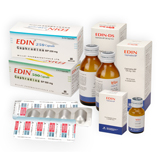
EDIN
Cephradine BP
Edin (Cephradine BP) is a Cephalosporin antibiotic
with broad spectrum bactericidal activity against both
gram-positive and gram-negative bacteria. It is also
highly active against most strains of penicillinase
producing staphylococci. The organisms sensitive to
Cephradine are :
Gram-positive
: Staphylococci (both penicillin sensitive
and resistant strains), Streptococci including both
Streptococcus pyogenes (beta haemolytic) and group D
streptococci (enterococci) and Streptococcus pneumoniae.
Gram-negative : E.
coli, Klebsiella, P. mirabilis, Haemophilus influenza,
Shigella spp. (Including Salmonella typhi) and Neisseria
spp. Enterococci (s. faecallis) and many strains of
E. coli and Staphylococcus aureus are also susceptible.
Edin (Cephradine) is rapidly absorbed from the
gastrointestinal tract. Absorption is delayed by presence
of food although the total amount absorbed is not appreciably
altered.
COMPOSITION :
Edin 250 capsule : Each capsule contains Cephradine
BP 250 mg.
Edin 500 capsule : Each capsule contains Cephradine
BP 500 mg.
Edin Dry Syrup : When dispensed each 5 ml. Contains
125 mg. of Cephradine BP activity.
Edin Drop : When dispensed each 1.25 ml. Contains
125 mg. of Cephradine BP activity.
INDICATION :
Edin (cephradine) is used in the treatment of
infections caused by sensitive organisms.
Upper respiratory tract infections : Pharyngitis,
sinusitis, otitis media, tonsilitis, laryngotracheo-bronchitis.
Lower respiratory tract Infections : Acute and
chronic bronchitis, lobar and bronchopneumonia.
Urinary tract infections : Cystitis, urethritis,
pyelonephritis.
Gastrointestinal tract infections : Bacillary
dysentery, enteritis, peritonitis.
Skin and soft tissue infections : Abscess, cellulitis,
furunculosis, impetigo.
Surgical prophylaxis : It is also used in preoperative
prophylactic administration (preoperatively, intra-operatively
and post-operatively). In cesarean section, intra-operative
(after clamping the umbilical cord) and post-operative
use may reduce the incidence of certain post-operative
infections.
DOSAGE AND ADMINISTRATION :
The dosage may be given without regard to meals.
Adult :
Oral : The usual dose is 1-2 gm daily in 2 to
4 divided doses. In severe and prolonged infection,
the dose can be increased up to 4 gm daily which should
be taken in equally divided doses.
Special dose in the following infections :
Skin and skin structures and respiratory tract infections
: Usual dose is 250 mg. every 6 hours or 500 mg every
12 hours.
Lobar Pneumonia : 500 mg every 6 hours or 1 gm
every 12 hours.
Urinary tract infections : Usual dose is 500
mg every 12 hours.
Gastro-intestinal tract infections : 500 mg three
to four times daily.
Children :
Oral : The usual total dose is 25 to 50 mg/kg/day
given in 2 to 4 equally divided doses.
Therapy should be continued for a minimum of 48-72 hrs,
after the patient becomes asymptomatic or evidence of
bacterial eradication has been obtained.
DOSAGE IN RENAL IMPAIRMENT
:
In patients with impaired renal function, doses and
frequency of administration of Cephradine must be modified
according to the degree of impairment, severity of infection,
susceptibillty of the causative organism and serum concentration
of the drug. For adults, a loading dose of 750 mg should
be given subsequently followed by 500 mg with the mentioned
time interval.
| Creatinine
clearance (ml/min) |
Time interval
(hrs.) |
| >20 |
6-12 |
| 15-19 |
12-24 |
| 10-14 |
24-40 |
| 5-9 |
40-50 |
| <5 |
50-70 |
For children, dosage schedule
may need to be adjusted.
Reconstitution & Administration
:
Oral Capsule or syrup : For the syrup, shake
the bottle well before adding water. Then add 60 ml
water after boiling (with the help of the provided teaspoon)
to the bottle. Then continue shaking the bottle gently
until the powder is dissolved properly. Shake the bottle
well before each use.
For drop : Add 10 ml water after boiling (two
teaspoonful) to the bottle.
Adverse Effect : Adverse effects include nausea, vomiting,
diarrhoea and abdominal discomfort. Allergic reactions
including skin rashes, urticaria, eosinophilia, angioedema
and anaphylaxis may occur and elevation of hepatic enzyme
values have been noted. Neutropenia has been reported.
Super-infection with resistant microorganisms, particulary
candida, may follow the treatment. There is also a possibility
of development of pseudomembranous colitis.
Precaution : Cephradine should be used with caution
in those patients who are known hypersensitive to penicillins.
Pregnancy and lactation : Although there have
been no reports of adverse effect on the fetus, safety
of use during pregnancy only when clearly indicated,
Cephalosporins are distributed into breast milk and
the drug should be used with caution in nursing women.
Pharmaceutical Precaution : Cephradine capsule,
dry powder for syrup and dry powder for drop should
be kept in a cool and dry place, protect from light.
HOW SUPPLIED :
Edin 500 capsule : Box containing 5 x 4 capsules
in Alu/Alu foil pack.
Edin 250 capsule : Box containing 5 x 6 capsules
in Alu/Alu foil pack.
Edin Dry Syrup : Bottle of 100 ml.
Edin Drop : Bottle of 15 ml.
|